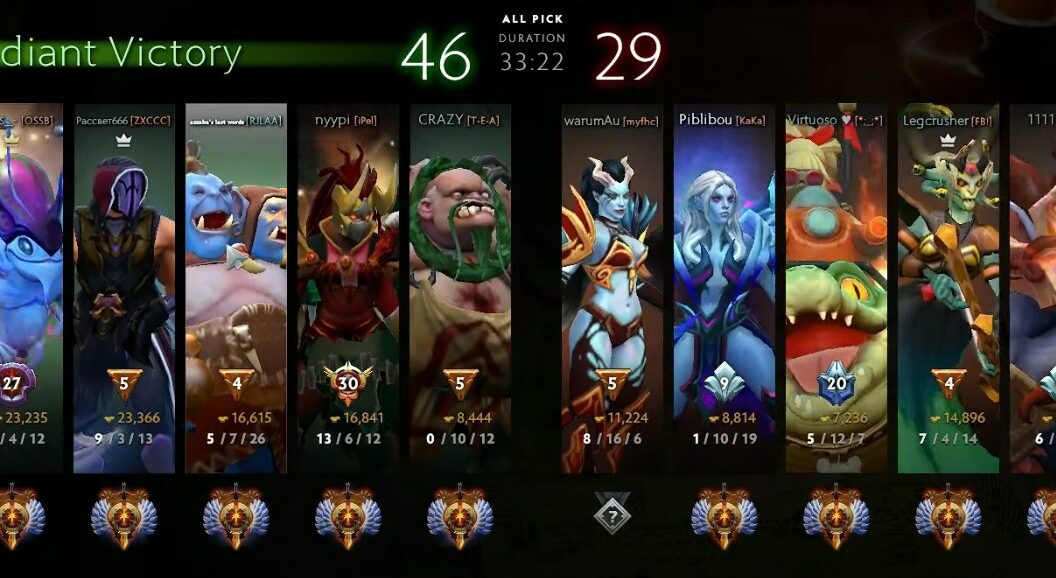
While many engage in Dota 2 gameplay purely for entertainment and aren’t overly concerned about the outcome, a substantial portion of the gaming community strives to climb the ranking ladder, aiming to secure their coveted ‘medal’ at the earliest. They typically stick to their preferred characters and aim to secure as many victories as they can.
Despite the interest in the Dota 2 hierarchy, not all gaming enthusiasts fully comprehend its intricacies. Valve, the game’s creator, significantly revamped the ranking system a few years ago, introducing ‘medals’ to signify a player’s progress. While there haven’t been many adjustments since, several players still struggle to fully grasp it. Therefore, we find it fitting to delve into the details of the D2 ranking framework.
Dota 2 Rank Structure Overview
The rank structure in Dota 2, although labeled differently by various gamers, essentially falls into two categories. The first relates to MMR (Match Making Rating), while the latter is commonly known as Medal Ranking. The Medal Ranking system, introduced a few years back, brought about significant changes to the game.
Regarding the medals, the game currently offers the following, based on your MMR:
- Herald;
- Guardian;
- Crusader;
- Archon;
- Legend;
- Ancient;
- Divine;
- Immortal.
Interestingly, each medal comes with five stages of advancement that players must progress through. Upon completion, gamers advance to the subsequent rank. The path to progression is straightforward – winning matches.
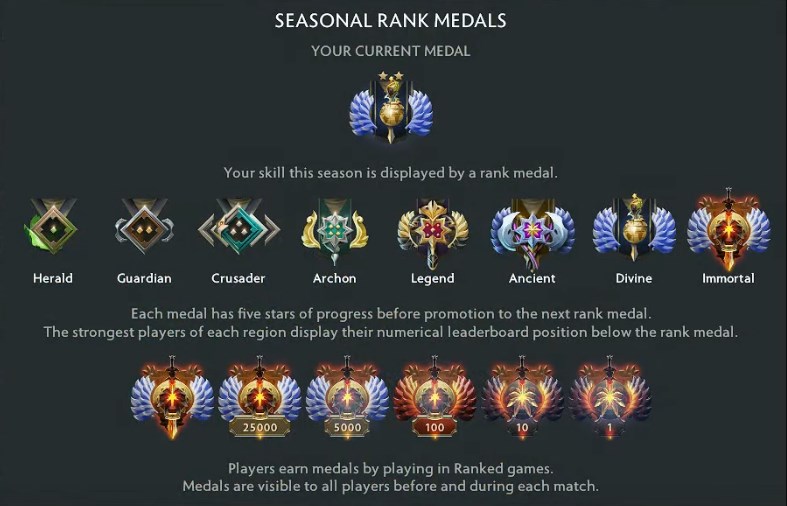
Reaching the Immortal rank changes the dynamics slightly. You’re no longer required to earn five stars for progress. Instead, you’re assigned a number that signifies your standing on the regional leaderboard.
It’s worth noting that medal earnings are exclusive to ranked matches, and your medal ranking is displayed to other gamers pre-match and during gameplay.
Understanding Calibration, Medals, and MMR
MMR holds significant importance in Dota 2 as it influences your medal ranking. To improve your MMR, you need to win ranked matches, either solo or in a team. Typically, a solo win grants 30 MMR, while a team win provides 20 MMR. For those unfamiliar, MMR stands for matchmaking rank, a score indicative of your skill level, mainly based on your win-loss record.
Your starting MMR for the season is dependent on calibration, which involves playing ten games, post which your MMR is disclosed. It remains a mystery if the system takes into account your wins and losses, but striving to win and showcasing your abilities can only be advantageous.
Before you can calibrate, you must have approximately 100 hours of Dota 2 under your belt. You can opt for other game modes besides ranked matches, including the standard All Pick in casual mode, and Turbo for quicker games.
Understanding the Cyclical Nature of Dota 2 Seasons
Navigating through Dota 2’s competitive ladder requires a good grasp of the game’s seasonal structure. In essence, a season in the game lasts approximately six months, necessitating players to recalibrate their ranking at the end of each cycle. The calibration process, typically involving ten games, acts as a performance review that can lead to a change in a player’s rank.
Key aspects of Dota 2’s seasons:
- Season Duration: Typically, each season lasts about half a year, allowing players ample time to develop their skills, climb the ranks, and make their mark;
- Calibration: This process is vital, acting as an evaluation of a player’s performance and potential adjustments to their ranking. While calibration can often result in similar rankings to previous seasons, significant improvements or declines in gameplay can lead to a change;
- Variable Season Lengths: Valve, the game’s developer, does not always stick to the six-month cycle, causing some seasons to extend longer. This irregularity has been addressed by Valve, giving players an option for mid-season recalibration;
- Mid-Season Calibration: A bonus recalibration option can be utilized once per season, which can be found in the game’s settings. This allows players another chance to impact their rankings positively during an extended season.
Demystifying Dota 2 Rankings and the Role of MMR
In Dota 2, your position in the competitive hierarchy is determined by your Match Making Rating (MMR). This rating system directly influences the rank and corresponding medal a player is awarded. Although a definitive list connecting MMR to ranks is yet to be officially released, several tests over recent years have indicated a consistent pattern.
Unraveling the MMR to Rank Correlation:
- Herald Rank: Starting from zero, this rank accommodates players up to an MMR of approximately 770. As players improve and gain MMR, they progress to higher ranks;
- Guardian to Ancient: As players continue to advance their skills and MMR, they move through the ranks of Guardian at 770 MMR, Crusader at 1540 MMR, Archon at 2310 MMR, Legend at 3080 MMR, and finally Ancient at 3850 MMR;
- Divine and Immortal: For players who have perfected their gameplay and aim for the top, the Divine bracket awaits at 4620 MMR. The ultimate accolade, the Immortal rank, is achieved when a player’s MMR surpasses 5420;
- Importance of MMR: It’s important to remember that a player’s MMR doesn’t only determine their rank, but also their matchmaking. Higher MMR players are matched with and against similarly skilled individuals, maintaining a balanced and challenging gameplay environment.
Dota 2 Rank System: Summarizing Table
| Rank | MMR |
|---|---|
| Herald | 0-770 |
| Guardian | 770-1540 |
| Crusader | 1540-2310 |
| Archon | 2310-3080 |
| Legend | 3080-3850 |
| Ancient | 3850-4620 |
| Divine | 4620-5420 |
| Immortal | 5420+ |
Remember, Dota is a game of continuous learning and improvement. Your MMR and rank aren’t merely badges of honor; they also represent your growth as a player. Whether you’re aiming for Immortal or just striving to beat your personal best, every bit of progress is a testament to your skill and dedication.
Discovering the Distribution of Ranks in Dota 2
Statistics offer an interesting perspective into the hierarchy of Dota 2 players, revealing how the ranks are dispersed amongst the gaming community. Various elements influence this distribution, but it’s been observed that a significant chunk of players generally falls within the range of Crusader 1 and Legend 2 ranks. This MMR bracket represents a group of gamers who have a solid foundation of the game’s basics and have strategized their way toward victory.
Key Insights into Dota 2 Rank Distribution:
- Varied Player Base: Dota 2 has a vast and diverse player base, spread across different skill levels. The rank distribution gives an idea of where most players lie on the skill spectrum;
- Concentration of Players: The bulk of Dota 2’s player base tends to cluster within the Crusader 1 to Legend 2 ranks. This implies that many players have moved beyond the beginner stages and have a good grasp of the game’s mechanics;
- Dynamic Nature: The distribution is not static; it’s continually changing as players improve, shift ranks, or new players join the game. Seasonal recalibration also adds to this dynamism;
- MMR Range: The MMR range from Crusader 1 to Legend 2 is a hotbed of players looking to elevate their game. Players within this range have demonstrated their understanding of the game’s core strategies and mechanics.
Mastering the Art of Climbing the Dota 2 Ranks
The journey up the Dota 2 ranking ladder can be a grueling challenge. Players often encounter numerous obstacles, sometimes causing even the most dedicated to consider surrendering. However, implementing the following strategies can aid in overcoming these hurdles.
Embrace the Meta:
- Stay Updated: Regular patches and updates often shake up the game’s meta, bringing different heroes into prominence. Staying abreast with these changes can give you a competitive edge;
- Smart Hero Selection: It’s advantageous to utilize the top-tier heroes of the current meta, but it’s equally crucial to select heroes you’re proficient with. The synergy of a meta hero and personal skill can significantly improve your win rate.
Negate the Negative Vibes:
- Coping with Negativity: In the vast world of gaming, encountering negative players is inevitable. However, focusing on your gameplay and maintaining a positive attitude can significantly enhance your experience;
- Maintain High Behavior Score: A high behavior score can reduce the probability of being matched with negative players. Being respectful and supportive in your games helps increase this score.
Adopt Strategies from the Pros:
- Watch and Learn: Observing professional Dota 2 players can provide a treasure trove of strategies and techniques. Their gameplay can serve as an excellent learning tool to refine your skills;
- Patience is Key: While this method requires time and patience, the potential rewards are significant. Regularly watching pro games can expose you to a variety of strategies, enabling you to adapt and respond to different in-game situations effectively.
Bottom Line
The Dota 2 ranking system, intricately woven into the game’s competitive structure, serves as a challenging yet rewarding pathway for players aiming to prove their skills. It operates based on distinct seasons, usually lasting six months, necessitating players to recalibrate their rankings periodically. This system maintains a delicate balance between skill levels, linking players’ Match Making Rating (MMR) directly with their standing in the game’s hierarchy.
The D2 player community is widespread across different skill levels, with a significant concentration in the MMR range of Crusader 1 to Legend 2. This shows that a large segment of the player base possesses a solid understanding of the game’s fundamentals and has already begun strategizing their ascent in the rankings.
However, climbing the ranking ladder in the game is no simple feat. It requires players to stay updated with the meta, remain focused amidst negativity, and continuously learn from seasoned players. The blend of persistence, adaptability, and continuous learning forms the cornerstone for any player seeking to ascend the ranks in Dota 2’s competitive landscape.