While some individuals play Dota 2 purely for enjoyment, many players are driven by the desire to achieve their desired rank and progress in the game. This often leads them to focus on winning and favoring their preferred hero.
However, the Dota 2 ranking system remains a mystery to a significant number of players. Valve implemented a notable update a few years ago, introducing the concept of ranks. Although there have been a few subsequent changes, some users still struggle to comprehend its intricacies. Therefore, it is essential to delve into the details of the Dota 2 rank system and gain a comprehensive understanding of its mechanics.
Overview
The Dota 2 ranking system can be divided into two main categories:
- MMR (Matchmaking Rating);
- Medal Ranking.
The latter gained popularity in recent years and brought significant changes to the system.
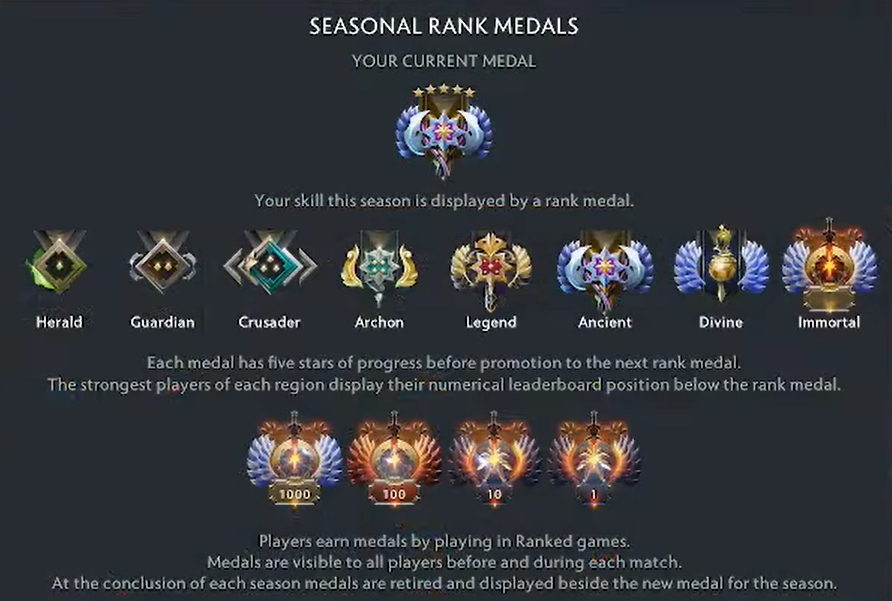
The Medal Ranking system introduces various medal options based on your MMR, including:
- Herald;
- Guardian;
- Crusader;
- Archon;
- Legend;
- Ancient;
- Divine;
- Immortal.
Each medal consists of five stars that represent your progress. Once you complete all five stars, you will be promoted to the next rank medal. Winning games is the key to advancing through the ranks.
Upon reaching the Immortal rank, the progression system shifts. Instead of earning stars, you receive a numerical rank that indicates your position on the leaderboard for your region.
It’s worth noting that these medals and rankings are visible to other players both before and during the match, adding an extra layer of competitiveness to the Dota 2 experience. Engaging in ranked games is the sole means of earning and displaying these prestigious accolades.
Dota 2’s Calibration, Medals, and MMR System
In Dota 2, your MMR (Matchmaking Rating) plays a crucial role as it determines your Dota 2 rank. Accumulating MMR requires participating in ranked games, whether solo or in a party, and emerging victorious. Typically, winning a ranked game solo grants you 30 MMR, while a party win earns you 20 MMR. MMR, short for matchmaking rank, serves as a score that reflects your skill level, based on your performance in wins and losses.
During the start of a season, your initial MMR is established through a process called calibration. This involves playing 10 games, after which the game will reveal your calibrated MMR. While the exact factors considered in calibration are unknown, it’s generally advisable to strive for victories and demonstrate your full potential.
Before embarking on the calibration process, you are required to have approximately 100 hours of Dota 2 gameplay. However, there are various alternative game modes available apart from ranked games, including the standard All Pick mode in casual play and the fast-paced Turbo mode, which offers quicker game sessions.
Exploring these options and honing your skills prior to calibration can contribute to a more accurate representation of your abilities when the time comes to showcase your performance in ranked games.
Breakdown of Dota 2’s Seasons and How They Affect Gameplay
When delving into the intricacies of Dota 2 ranks, one of the key aspects to understand is the existence of seasons within the game. Typically, a season spans approximately 6 months, after which players are required to recalibrate their ranks. While there are occasional exceptions, the majority of players tend to retain their previous rank upon recalibration.
However, it’s important to note that Valve’s approach to seasons is somewhat inconsistent, occasionally resulting in longer season durations. Recognizing this, the company has introduced an option for players to recalibrate their ranks once per season. This feature can be accessed through the options menu, allowing players to initiate the recalibration process.
By providing players with the ability to recalibrate, Valve acknowledges the need for flexibility and recognizes that skill levels and performance may evolve over time. As players embark on the recalibration journey, they have an opportunity to showcase their progress and potentially achieve a new rank that reflects their growth and development in Dota 2.
Unveiling the Relationship Between Dota 2 Ranks and MMR
In the realm of Dota 2, your Matchmaking Rank (MMR) is intricately connected to your rank within the game. While an official list of Dota 2 ranks and their corresponding medals may not be confirmed, extensive testing and observations over the past years have shown consistent patterns.
The journey begins with the Herald rank, encompassing players with MMRs ranging from 0 up to approximately 770. Progressing further, the Guardian 1 rank awaits as you surpass the 770 MMR milestone. Achieving a total MMR of 1540 will propel you into the Crusader rank, while a climb to 2310 MMR will grant you entry into the Archon 1 rank. The pursuit of excellence continues with a target of 3080 MMR for Legend 1 and an ambitious aim of 3850 MMR for the coveted Ancient 1 rank.
For those aspiring to reach the upper echelons, the Divine bracket beckons at the threshold of 4620 MMR, while the Immortal rank requires surpassing the 5420 MMR mark.
While these ranks and MMR thresholds serve as guidelines, it’s essential to understand that the Dota 2 matchmaking system evaluates various factors beyond just MMR. This includes game performance, win-loss ratios, and the overall skill level of the player.
As you embark on your Dota 2 journey, the interplay between MMR and ranks will shape your path, marking milestones of progress and achievement. Climb the ladder, test your skills, and strive for greatness as you aim to conquer Dota 2’s vast and competitive landscape.
Unveiling the Distribution of Dota 2 Ranks
Exploring the vast landscape of Dota 2, it is intriguing to examine the distribution of players across different ranks. While this distribution varies due to numerous factors, a substantial portion of Dota 2 players can be found within the Crusader 1 to Legend 2 range. Within this MMR spectrum, players showcase a solid grasp of the game’s fundamentals and possess the knowledge required to secure victories.
Rank distribution in the Dota 2:
| Rank | MMR Range |
|---|---|
| Herald | 0 – 770 |
| Guardian | 770 – 1540 |
| Crusader | 1540 – 2310 |
| Archon | 2310 – 3080 |
| Legend | 3080 – 3850 |
| Ancient | 3850 – 4620 |
| Divine | 4620+ |
| Immortal | Top Rankings |
Strategies for Climbing Dota 2’s Highest Ranks
Reaching the desired rank in Dota 2 is no walk in the park. It’s a journey filled with challenges that can often lead some players to give up. However, armed with the right knowledge and approach, you can increase your chances of success. Here are valuable tips and tricks to aid you in your quest.
Embrace the Meta:
Staying up-to-date with the current meta is crucial for climbing the ranks. Each patch introduces heroes that are more effective than others. However, only choose heroes you are comfortable playing and understand their mechanics. Picking a strong hero without the necessary knowledge can be detrimental to your team.
Ignore the Haters:
Dota 2 has its fair share of toxic players who love to flame and disrupt games. Don’t let their negativity affect your performance. Focus on your own gameplay and strive to carry your team to victory. Additionally, maintaining a high behavior score increases the likelihood of teaming up with more positive teammates, so be courteous and supportive.
Learn from the Best:
Watching top-tier Dota 2 players in action can be a valuable learning experience, especially for newcomers. Observe their strategies, decision-making, and mechanical skills. Studying their gameplay can provide insights that help you improve and elevate your own performance. While it requires time and effort, those who study the best often find success.
Continuous Self-Improvement:
Dedicate yourself to self-improvement by analyzing your own replays. Identify areas where you can enhance your gameplay, such as map awareness, last-hitting, positioning, or team fight execution. Recognize your strengths and weaknesses, and actively work on refining your skills through practice and focused gameplay.
Communication and Teamwork:
Effective communication and teamwork are essential for winning ranked matches. Coordinate with your teammates, share information, and make strategic decisions together. Remember, Dota 2 is a team game, and cooperation can often turn the tide in your favor.
Adaptability:
Be flexible and adapt your playstyle based on the flow of the game. Recognize the strengths and weaknesses of your team and the enemy team. Adjust your item builds and skill choices accordingly. Being versatile and adaptable will give you an edge in different scenarios.
Maintain a Positive Mindset:
A positive mindset is key to maintaining focus and resilience during challenging matches. Even in the face of setbacks, stay optimistic and encourage your teammates. Believe in your abilities and the potential for a comeback.
Conclusion
Understanding the rank system in Dota 2 is crucial for any player looking to improve their skills and climb the ladder. Whether it’s through calibration, medals, or MMR, knowing how to navigate the system and make progress is key. By following the tips and strategies outlined in this article, players can work towards achieving their goals and reaching new heights in their Dota 2 gameplay. With dedication, practice, and a solid understanding of the rank system, anyone can become a successful Dota 2 player and achieve their desired rank.